 |
libDwm-0.9.45
|
 |
| |
libDwm-0.9.45
|
|
This template class provides an associative container keyed by IPv4 addresses, with longest-match searching. More...
#include <DwmIpv4Routes.hh>
Public Types | |
| typedef std::unordered_map< Ipv4Address, _valueT, OurIpv4AddressHash > | _RepSubType |
| typedef _RepSubType::const_iterator | const_iterator |
Public Member Functions | |
| Ipv4Routes () | |
| Constructor. | |
| void | Clear () |
| Clears all entries. | |
| bool | Empty () const |
| Returns true if there are no entries. | |
| bool | Add (const Ipv4Prefix &prefix, const _valueT &value) |
| Adds an entry. | |
| void | Add (const Ipv4Routes< _valueT > &routes) |
Bulk add all routes. Note this will overwrite existing routes. | |
| _valueT & | operator[] (const Ipv4Prefix &prefix) |
| operator [] works like you would expect from an STL map. | |
| bool | Delete (const Ipv4Prefix &prefix) |
Deletes the entry for prefix. | |
| bool | Find (const Ipv4Prefix &prefix, _valueT &match) const |
Find the entry for the given prefix. | |
| void | FindInSubMap (const _RepSubType &subMap, Ipv4Address ipAddr, std::pair< bool, _valueT > &result) const |
| bool | NewFindLongest (const Ipv4Address &ipAddr, std::pair< Ipv4Prefix, _valueT > &match) const |
| bool | FindLongest (const Ipv4Address &ipAddr, std::pair< Ipv4Prefix, _valueT > &match) const |
Finds the longest match for ipAddr. | |
| bool | FindLongest (const Ipv4Address &ipAddr, std::pair< Ipv4Prefix, const _valueT * > &match) const |
Finds the longest match for ipAddr. | |
| bool | Find (const Ipv4Address &ipAddr, std::vector< std::pair< Ipv4Prefix, _valueT > > &matches) const |
Finds all matches for ipAddr. | |
| void | MaxLoadFactor (float loadFactor) |
| bool | operator== (const Ipv4Routes< _valueT > &r) const |
| operator == It's unlikely you'd ever need to use this, and it's expensive. | |
| bool | operator!= (const Ipv4Routes< _valueT > &r) const |
| operator != It's unlikely you'd ever need to use this, and it's expensive. | |
| uint32_t | Size () const |
| Returns the number of routes. | |
| void | HashSizes (std::vector< std::pair< uint8_t, uint32_t > > &sizes) const |
| uint64_t | StreamedLength () const |
| std::istream & | Read (std::istream &is) |
| Reads the routes from an istream. Returns the istream. | |
| std::ostream & | Write (std::ostream &os) const |
| Writes the routes to an ostream. Returns the ostream. | |
| size_t | Read (FILE *f) |
| Reades the routes from a FILE pointer. | |
| size_t | Write (FILE *f) const |
| Writes the routes to a FILE pointer. | |
| ssize_t | Read (int fd) |
| Reads the routes from a file descriptor. | |
| ssize_t | Write (int fd) const |
| Writes the routes to a file descriptor. | |
| int | Read (gzFile gzf) |
| Reads the routes from a gzFile. | |
| int | Write (gzFile gzf) const |
| Writes the routes to a gzFile. | |
| int | BZRead (BZFILE *bzf) |
| Reads the routes from a BZFILE pointer. | |
| int | BZWrite (BZFILE *bzf) const |
| Writes the routes to a BZFILE pointer. | |
| template<typename BinaryPredicate > | |
| void | Coalesce (BinaryPredicate pred) |
| Combines adjacent prefixes that can be combined (same value and prefixes can be represented by a prefix with a mask length one bit wider), then removes specific prefixes that are covered by a wider prefix with the same value. | |
| void | Coalesce () |
| void | GetAllKeys (std::vector< Ipv4Prefix > &keys) const |
| void | SortByKey (std::vector< std::pair< Ipv4Prefix, _valueT > > &target, bool ascending=true) const |
| void | SortByValue (std::vector< std::pair< Ipv4Prefix, _valueT > > &target) |
| Sorts the contained pair<Ipv4Prefix,_valueT> values into a vector, in descending order by the value stored for each prefix. | |
| uint32_t | AddressesCovered () const |
| Returns the number of addresses covered by the contained prefixes, not including 0/0. | |
| const std::array< _RepSubType, 33 > & | HashMaps () const |
| Returns a const reference to the contained hash maps. | |
Protected Member Functions | |
| template<typename BinaryPredicate > | |
| bool | HaveWiderMatch (const Ipv4Address &addr, uint8_t maskLen, const _valueT &val, BinaryPredicate pred) const |
Protected Attributes | |
| std::array< _RepSubType, 33 > | _hashMaps |
This template class provides an associative container keyed by IPv4 addresses, with longest-match searching.
While this isn't as speedy to search as Patricia or radix, it is based on STL containers and is hence easy to understand and maintain (note how few lines of actual code are here).
I/O functionality is provided, but the real work there is done in the Dwm::IO class.
I tested this class with a global IPv4 routing table from October 7, 2005. It contained 178,567 unique prefixes. The code was compiled with 'g++ -O2 ...' and run on a Xeon 2.8GHz host running FreeBSD 5.3. Each test looked up one address from each of the 178,567 prefixes, and was run 10 times.
FindLongest(const Ipv4Address &, std::pair<Ipv4Prefix,_valueT> &)
FindLongest(const Ipv4Address &, std::pair<Ipv4Prefix,_valueT *> &)
In October 2007 I switched to using <unordered_map> for the internal containers. I set the max_load_factor to .15 and get 1,168,000 lookups/sec for Ipv4Routes<uint32_t> when calling FindLongest(const Ipv4Address &, std::pair<Ipv4Prefix,_valueT> &) and 1,489,081 lookups/sec with Ipv4Routes<string> when calling FindLongest(const Ipv4Address &, std::pair<Ipv4Prefix,_valueT *> &)
More current measurements in 2020 on a Threadripper 3960X: roughly 5.3 million lookups/second for Ipv4Routes<string>.
Note: I don't consider this code fast for lookups; it's a tradeoff. You can get much faster lookups with sorted instances of std::vector, but at the expense of poor average insertion and deletion (and linear in the size of each vector in the worst-case). On modern CPUs, cache-friendly containers like std::vector are a big advantage for lookups if you keep them sorted, but keeping them sorted is expensive. A quick hack using sorted std::vector and std::lower_bound yield about a 10X improvement in lookups but a severe penaly for insertions. This would be less true if the typical prefix length distribution was close to normal, but in the real world it's typically heavy-tailed with the peak between /22 and /24.
|
inline |
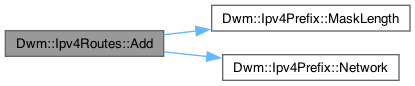
Adds an entry.
Returns false (and does nothing) if there was already an entry present for prefix.
|
inline |
Reads the routes from a BZFILE pointer.
Returns the number of bytes read on success, -1 on failure.

|
inline |
Writes the routes to a BZFILE pointer.
Returns the number of bytes written on success, -1 on failure.

|
inline |
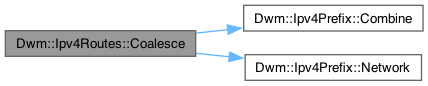
Combines adjacent prefixes that can be combined (same value and prefixes can be represented by a prefix with a mask length one bit wider), then removes specific prefixes that are covered by a wider prefix with the same value.
While we accept a predicate used to compare the two values, it only makes sense to use std::equal_to<_valueT>() or an equivalent since we make no guarantee of which of the two values we will use in the combined entry.
|
inline |
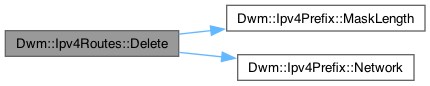
Deletes the entry for prefix.
Returns true on success, false if an entry wasn't found for prefix.
|
inline |
Finds all matches for ipAddr.
Places the results in matches (in longest-match-first order) and returns true if any matches were found. Returns false if no matches were found.

|
inline |
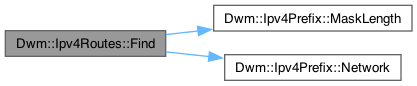
Find the entry for the given prefix.
If an entry is found, the value is stored in match and true is returned. Else false is returned.
|
inline |
Finds the longest match for ipAddr.
Places the result in match and returns true on success. Returns false if no match was found for ipAddr.

|
inline |
Finds the longest match for ipAddr.
Places the result in match and returns true on success. Returns false if no match was found for ipAddr. Note that match.second is a pointer to const for the value stored under the prefix. That means you need to be careful using this member; don't call free() or delete() on match.second.

|
inline |
operator != It's unlikely you'd ever need to use this, and it's expensive.
It's mainly here for unit testing.
|
inline |
operator == It's unlikely you'd ever need to use this, and it's expensive.
It's mainly here for unit testing.
|
inline |
Reades the routes from a FILE pointer.
Returns 1 on success, 0 on failure.

|
inline |
Reads the routes from a gzFile.
Returns the number of bytes read on success, -1 on failure.

|
inline |
Reads the routes from a file descriptor.
Returns the number of bytes read on success, -1 on failure.

|
inline |
Sorts the contained pair<Ipv4Prefix,_valueT> values into a vector, in descending order by the value stored for each prefix.
For example, if you had an Ipv4Routes<uint32_t> object, target would contain the pair<Ipv4Prefix,_valueT> objects sorted in descending order by the uint32_t values.

|
inline |
Writes the routes to a FILE pointer.
Returns 1 on success, 0 on failure.

|
inline |
Writes the routes to a gzFile.
Returns the number of bytes written on success, -1 on failure.

|
inline |
Writes the routes to a file descriptor.
Returns the number of bytes written on success, -1 on failure.
